Determinant
What is a Determinant?
The determinant is a special number associated with a square matrix that tells us important information about the linear transformation represented by that matrix. It's a fundamental concept in linear algebra that connects geometry with algebra.
Geometric Interpretation
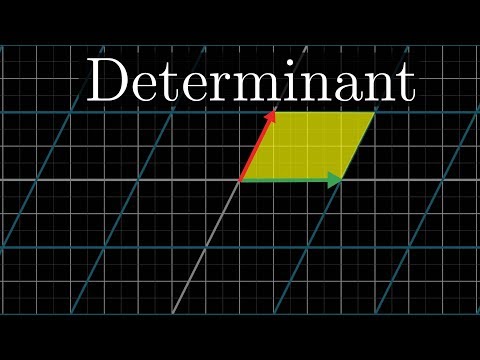
The determinant of a 2×2 matrix represents the area scaling factor of the linear transformation:
- If the determinant is 2, the transformation doubles the area
- If the determinant is 0.5, the transformation halves the area
- If the determinant is negative, the transformation flips the orientation
For 3×3 matrices, the determinant represents the volume scaling factor.
Connection to Invertibility
The determinant is intimately connected to matrix invertibility:
- A matrix is invertible if and only if its determinant is non-zero
- This makes sense geometrically: if a transformation squishes space into a lower dimension (determinant = 0), we can't "unsquish" it back to its original form
- The determinant of the inverse matrix is the reciprocal of the original determinant: det(A⁻¹) = 1/det(A)
Visual Understanding
For an excellent visual explanation of determinants, check out this video from 3Blue1Brown:
Properties
- det(AB) = det(A) × det(B)
- det(A⁻¹) = 1/det(A) (when A is invertible)
- det(Aᵀ) = det(A)
- det(cA) = cⁿ det(A) (where n is the dimension of the matrix)
Calculation
For a 2×2 matrix:
|a b|
|c d|
The determinant is: ad - bc
For larger matrices, we can use cofactor expansion or row reduction techniques.
Applications
- Determining if a system of linear equations has a unique solution
- Finding eigenvalues
- Computing volumes and areas in higher dimensions
- Understanding geometric transformations