Linear Dependence
Definition
A set of vectors from a Vector Space is linearly dependent if there exist scalars , not all zero, such that:
If no such scalars exist (or equivalently, if implies all ), then the vectors are linearly independent.
Visual Examples
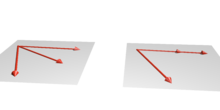
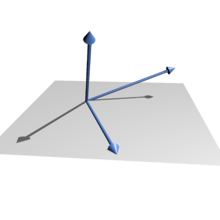
Examples
In
Consider the vectors:
These are linearly dependent because
In Polynomial Space
The polynomials and are linearly independent because no non-zero scalar multiple of one equals the other.
Properties
- Any set of vectors containing is linearly dependent
- Any set containing a vector that's a Linear Combination of others is dependent
- A single non-zero vector is always linearly independent
- Adding a vector to a linearly independent set might create dependence
Why Do We Care?
Linear independence helps us:
- Find Bases for vector spaces
- Determine minimal generating sets
- Calculate Dimensions of spaces
- Solve systems of equations efficiently
Think of linear independence as a way to identify when vectors are truly "different" from each other - when none can be created from combinations of the others.
Exercise
Prove that if is linearly dependent, then one of the vectors can be written as a linear combination of the others.