Matrices
Definition
A matrix is a rectangular array of numbers, symbols, or expressions arranged in rows and columns. Formally, an matrix has rows and columns:
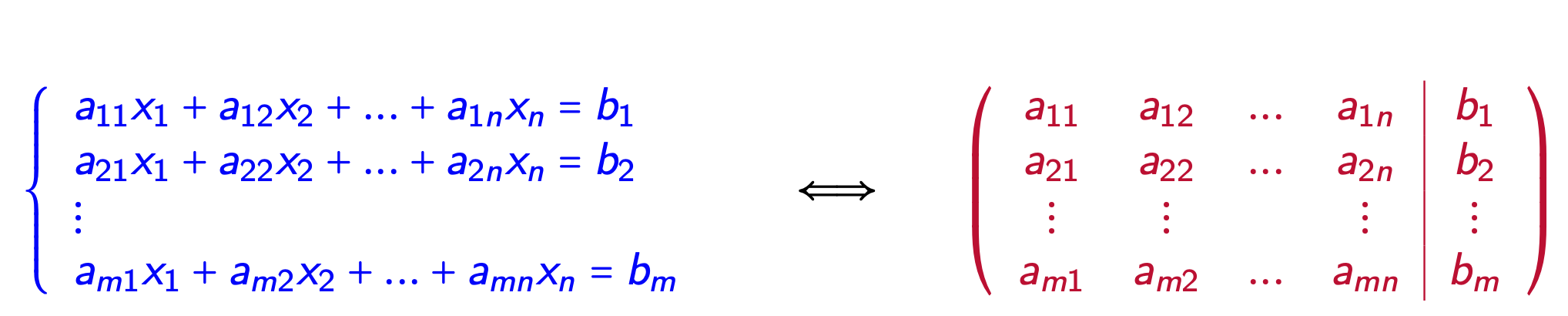
Augmented Matrices as Systems of Linear Equations
Types of Matrices
- Square Matrix: A matrix with the same number of rows and columns ()
- Identity Matrix: A square matrix with 1's on the main diagonal and 0's elsewhere
- Augmented Matrix: A matrix used to represent a system of linear equations
- Zero Matrix: A matrix with all elements equal to zero
- Diagonal Matrix: A square matrix with non-zero elements only on the main diagonal
- Triangular Matrix:
- Upper triangular: non-zero elements only on and above the main diagonal
- Lower triangular: non-zero elements only on and below the main diagonal
- Symmetric Matrix: A square matrix equal to its transpose ()
Matrix Operations
Addition and Subtraction
For matrices and of the same dimensions:
Scalar Multiplication
For a scalar and matrix :
Matrix Multiplication
For an matrix and an matrix :
Transpose
The transpose of an matrix is the matrix where:
Properties and Applications
Determinant
For a square matrix, the determinant is a scalar value that provides information about the matrix's invertibility and the volume scaling factor of the linear transformation it represents.
Inverse
A square matrix has an inverse if , where is the identity matrix.
Rank
The rank of a matrix is the dimension of the vector space generated by its columns (or rows).
Eigenvalues and Eigenvectors
For a square matrix , a non-zero vector is an eigenvector with eigenvalue if .
Applications
Systems of Linear Equations: Matrices provide a compact way to represent and solve systems using methods like Gaussian elimination and Row-Reduced Echelon Form.
Linear Transformations: Matrices represent linear transformations between vector spaces.
Computer Graphics: Transformation matrices are used for rotation, scaling, and translation in 2D and 3D graphics.
Data Science: Matrices are fundamental in techniques like Principal Component Analysis (PCA) and Linear Regression.
Quantum Mechanics: Matrices represent observables and transformations in quantum systems.
Computational Methods
Various algorithms exist for matrix operations, including:
- LU Decomposition
- QR Factorization
- Singular Value Decomposition (SVD)
- Eigenvalue Decomposition