Row-Reduced Echelon Form (RREF)
Definition
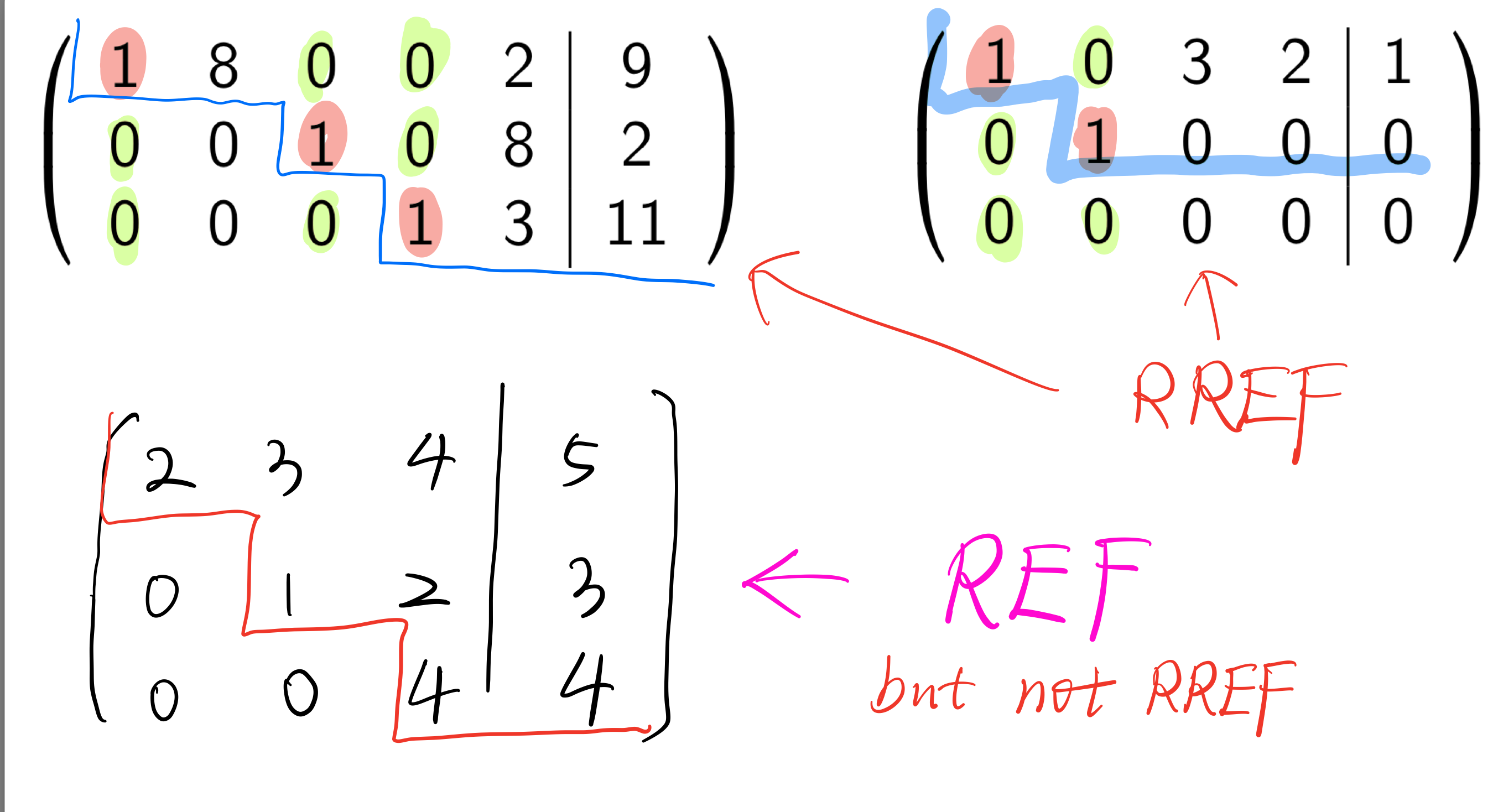
A matrix is in Row-Reduced Echelon Form (RREF) if it satisfies the following conditions:
- All rows consisting entirely of zeros are at the bottom of the matrix.
- The leading entry (first non-zero element) of each non-zero row is 1 (called a pivot).
- Each leading 1 appears to the right of the leading 1 in the row above it.
- Each leading 1 is the only non-zero entry in its column.
Visual Representation
Importance
RREF is a standardized form that makes it easy to:
- Identify the solution set of a system of linear equations
- Determine the rank of a matrix
- Find a basis for the column space, row space, and null space
- Identify whether a system has a unique solution, infinitely many solutions, or no solution
Relationship to Gaussian Elimination
RREF is the end result of the Gaussian elimination process. While Gaussian elimination describes the procedure, RREF describes the final form we want to achieve.
Example
Consider the augmented matrix representing the system of equations:
The augmented matrix is:
After applying Gaussian elimination, the RREF is:
This tells us that the unique solution is , , and .
Properties
- Uniqueness: Every matrix has a unique RREF.
- Row Operations: RREF is achieved through elementary row operations:
- Swapping rows
- Multiplying a row by a non-zero scalar
- Adding a multiple of one row to another
- Rank: The number of non-zero rows in the RREF equals the rank of the matrix.